What to see at Schloss Linderhof, in the order you meet it
The approach, and what the building actually is
Linderhof sits in the Graswangtal with wooded slopes on both sides, and the first thing worth knowing is the scale. This is the smallest of Ludwig II’s three palaces and it is the only one he lived to see finished. People arriving from Neuschwanstein in the morning — which is what most day trips do — arrive expecting something on that scale and find a building you could walk round in a few minutes. It is worth resetting that before you get out of the vehicle.
The ground was already royal before he touched it. It held King Maximilian II’s hunting lodge, the Königshäuschen. Ludwig began enlarging it in 1869; in 1874 the old lodge was taken down and re-erected elsewhere in the park, three rooms and a staircase were added, and the wooden exterior was replaced with stone. It was finished in 1878, and he had been living there most of the time since 1876. In July 2025 it became part of a UNESCO World Heritage inscription covering Ludwig’s royal palaces.
The palace tour
You see the inside on a guided tour and no other way. It leaves every five to ten minutes, lasts about 25 minutes, takes a maximum of 40 people and runs in German and English. There is no self-guided route and no way to linger.
What the administration says about the interior is that it is Second Rococo — Neo-Rococo — with motifs from the age of Louis XV, inside a Baroque exterior, and with a strong South German influence the administration traces to the Amalienburg. That combination is the reason the rooms feel dense rather than grand: this is a small building carrying an amount of decoration sized for a much larger one. Reviewers split on it fairly reliably, and the split is about exactly that.
The eleven rooms, in the order the tour takes them
This is the administration’s own route, in its own order, with the German name your guide will use beside each. What is in each room is not on this page: nothing I can point you at itemises the contents, so the guide describes them while you are standing there and I do not pretend to from here.
| Room | As the guide will name it | |
|---|---|---|
| 1 | Vestibule | Vestibül |
| 2 | Western Gobelin Room | Westliches Gobelinzimmer |
| 3 | Yellow Cabinet | Gelbes Kabinett |
| 4 | Audience Room | Audienzzimmer |
| 5 | Lilac Cabinet | Lila Kabinett |
| 6 | Bedroom | Schlafzimmer |
| 7 | Rose Cabinet | Rosa Kabinett |
| 8 | Dining Room | Speisezimmer |
| 9 | Blue Cabinet | Blaues Kabinett |
| 10 | Eastern Gobelin Room | Östliches Gobelinzimmer |
| 11 | Hall of Mirrors | Spiegelsaal |
Now do the division, because it is the most useful thing on this page. Eleven rooms in about twenty-five minutes is roughly two minutes a room. That is the pace, it is not negotiable, and it is why people who arrive expecting to linger over a cabinet leave irritated. You are walked through a house at the speed of the slowest person in a party of forty, and the party behind yours sets off five minutes later.
The two Gobelin rooms bracket the middle of the route and the four cabinets — Yellow, Lilac, Rose, Blue — are the small rooms between the large ones, which is why the tour feels quicker in the second half than the first. The Hall of Mirrors is last.
You cannot photograph any of them
You may not take photographs or video inside. Not in the palace, not in the Venus Grotto, not in the Royal Lodge. Outside in the park, photography for your own use is free. The administration says so in one sentence on its visitor page: “In Schloss Linderhof, in der Venusgrotte, im Königshäuschen und im Königshaus am Schachen sind Foto- und Videoaufnahmen leider nicht gestattet.”
Take that seriously when you plan the twenty-five minutes, because it changes what they are for. You are not gathering material to look at later; you are looking at the thing once, at walking pace, and then you are outside again. I would rather be told that in advance than discover it in the vestibule.
Why every interior photograph you find is old
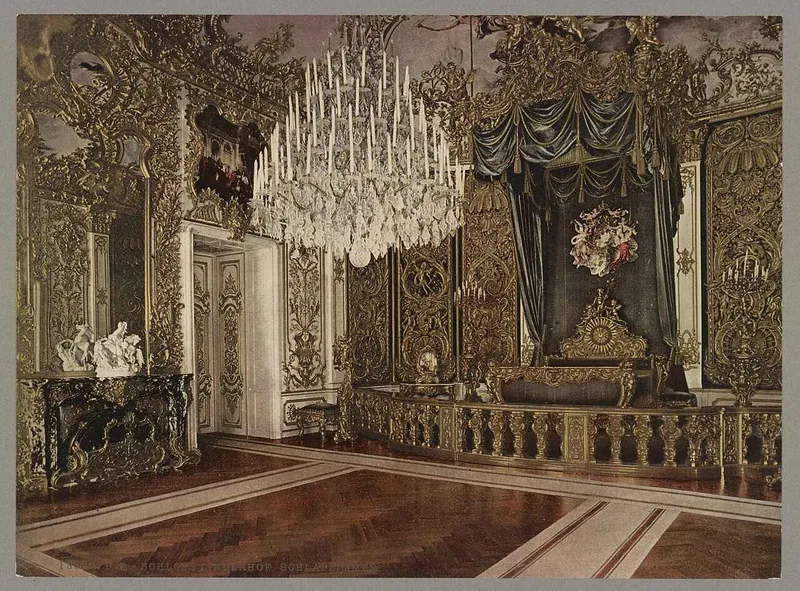
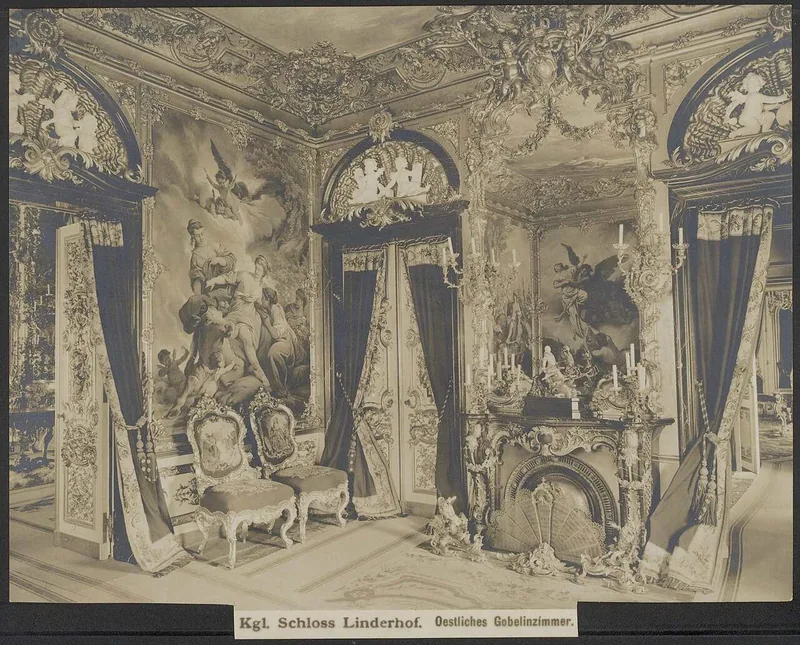
Here is a consequence of that rule which I did not expect and think is worth passing on. I went looking for pictures of the inside of this palace and found almost none that were not decades old. Not a few — almost none.
The Wikimedia pool for Linderhof holds 802 files, and exactly four of them are interiors. All four are archival, and their sources are the Library of Congress, a photographer who died in 1990, and the Dutch national archive. That is not a gap in the archive. It is the photography rule showing up as a hole in the supply of pictures: the old ones are all there are, because new ones are not being made.
So when you see a warm, crowded, gilded interior of Linderhof on a page somewhere, look at how old it is. Two of the four are below and a third is on the Hall of Mirrors page. They are the ones this site can use, and they are the ones everybody else is using too.
Who built it
Four names worth having, because they are the ones the administration credits and because most pages about this palace credit only the king.
- Georg von Dollmann — principal architect, responsible for the structure and for the wings from 1870.
- Carl von Effner — court garden director, who laid out the park from 1874.
- Julius Hofmann — the last enlargement, and the rebuilding of the bedroom in 1885/86. That is the sixth room on the list above, and it was still being rebuilt in the last months of the king’s life.
- Philipp Perron made the sculptural decoration of the façades, and Franz Walker the Atlas figure on the main gable — the thing to look up at while you are waiting for your tour number.
The Hall of Mirrors page answers the question people actually type about the last room, which is whether it is the Versailles one. It is not.
The park, which is the longer half of the day
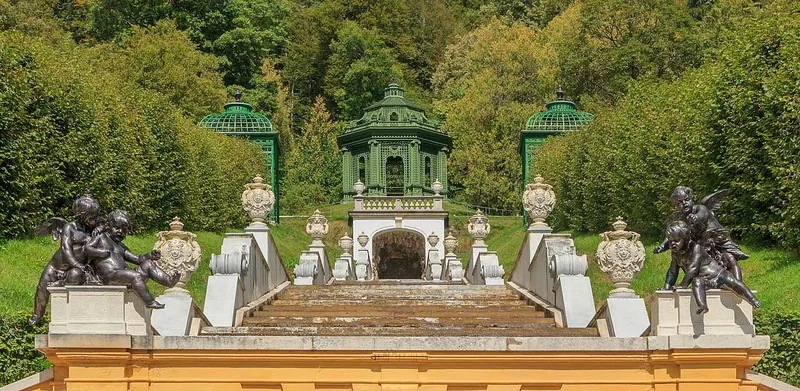
The gardens are by the court garden director Carl von Effner and they are the reason to allow more time than the tour needs. The park and the park buildings that are open need no ticket. In summer the fountains play every half hour between 9:00 and 18:00, April to October, with the administration’s own note that capacity may be reduced by water shortage.
The order below is the one I walk it in. The park does not enforce a route and nobody publishes an official one, so take it as a guide’s habit rather than a rule. And unlike the eleven rooms, you can photograph every bit of it.
- The Venus Grotto — built 1875–1877, lit by electric bulbs from 1877, and restored over roughly ten years before reopening in April 2025. It has its own ticket and its own tour, it takes 50 people every 20 minutes, and it is summer only. It is the thing here that exists nowhere else. The grotto.
- The Moorish Kiosk — under renovation and scaffolded, visible from neither outside nor inside. The administration hopes to reopen the interior for the 2028 season. Plan without it.
- The Moroccan House — built in Morocco for the Vienna International Exhibition of 1873, bought by the king in 1878, and standing in its present place in the park since 1998.
- Hunding’s Hut and the Hermitage of Gurnemanz — open 11:00 to 18:00 in the summer half-year, shut all winter.
- The Royal Lodge exhibition — the one park building with any winter opening at all, and the only one with its own admission.
The park buildings page has each of them properly, including what this site does and does not know about the two that are only ever given opening hours.
Do the grotto tour before the palace tour if you are buying both and the day is busy. The grotto runs every twenty minutes and takes fifty; the palace runs every five to ten and takes forty. The palace is the easier of the two to slot into a gap, so hold it back.
How long the whole thing takes
Twenty-five minutes inside for eleven rooms, fifteen more if you do the grotto, and then as long as the weather allows outside. Most people who enjoy this place spend the majority of their time in the park, and most people who leave disappointed budgeted for a palace visit and got one. How long you need does the arithmetic; is it worth it answers the question underneath it.
Read next
- The Venus Grotto — the one thing here that is nowhere else.
- The Hall of Mirrors, and why it is not the Versailles one.
- The park buildings, in order.
- The king who built it.
Frequently asked questions
What is Linderhof Palace known for?
Being the smallest of Ludwig II’s three palaces and the only one he lived to see finished, in 1878; for its Second Rococo interior inside a Baroque exterior; for Carl von Effner’s gardens; and for the Venus Grotto, an artificial cave lit by electric bulbs from 1877.
What is Linderhof Palace?
A palace in the Graswangtal near Ettal, built for King Ludwig II between 1869 and 1878 on the site of his father’s hunting lodge. It is the smallest of his three palaces, the only one completed in his lifetime, and since July 2025 part of a UNESCO World Heritage inscription.
Can you take photographs inside Linderhof?
No. The palace administration does not permit photographs or video inside the palace, the Venus Grotto or the Royal Lodge. It is why almost every interior picture of Linderhof in circulation is archival: of 802 Wikimedia files on this palace, exactly four are interiors and all four are old.
How many rooms do you see at Linderhof?
Eleven, in this order: Vestibule, Western Gobelin Room, Yellow Cabinet, Audience Room, Lilac Cabinet, Bedroom, Rose Cabinet, Dining Room, Blue Cabinet, Eastern Gobelin Room and the Hall of Mirrors. Eleven rooms in about 25 minutes is roughly two minutes a room, which is the honest measure of the pace.